Wednesday, April 2, 2014

Tuesday, April 1, 2014
CoD Midway
So I'm now halfway through CoD

The style of Confederacy of Dunces is hard to place. It's definitely a far cry from the very simplistic craft of Vonnegut. It's use of complex sentences and difficult vocabulary make it give a very refined feel, reminding me of Joyce, in a way. This actually sort of misleads a reader's portrayal of Ignatius, making him out as a man who makes at least a little bit of sense.
This is where we get ignatius himself. Ignatius is a classic example of a caractère qui ne sait rien, or a character that knows nothing. All he does is sit around all day, expecting his mother to do everything from him.
As most people reading this blog should have picked up, Ignatius frequently wears a green hunting hat. "But wait, John. Holden also wore a red hunting hat!"you say. Congratulations, you looked up Catcher in the Rye on sparknotes. Give yourself a pat on the back.
Of course, this choice of hunting hat is important. For one, Holden and Ignatius are common in that their sense of the world is different from the world around them. Holden is an idealist, while Ignatius is such a pessimist that he ends up wrapping around the earth and becoming an idealist again. Like the color, there is a significant difference between these two individuals: while Holden experiences change in his idealism (Helped by him going to New York), Ignatius is contempt with just sitting in his mother's house, doing nothing, except for occasionally watching movies.
"When the credits had ended and Ignatius had noted that several of the actors, the composer, the director, the hair designer, and the assistant producer were all people whose efforts had offended him at various times in the past" (36)
This quote exemplifies Ignatius' shallow views. Despite that fact that he has very likely never met any of the people that he mentioned here, he believes that they have "offended him," which, you know, usually requires deliberate action on the offending person part. So, what offended him?
"On the second chorus the entire ensemble joined in the song, smiling and singing lustily about ultimate success while they swung, dangled, flipped, and soared. “Oh, good heavens!” Ignatius shouted, unable to contain himself any longer. Popcorn spilled down his shirt and gathered in the folds of his trousers. “What degenerate produced this abortion?”" (37)
Singing and dancing! Ignatius must be fun at parties.
Overall, though it might have started cold, I'm starting to find myself warming up to this book. Though the humor is very subtle it's usually hilarious. I am excited to keep reading this book.
Saturday, March 29, 2014
Where there will be no "Confederacy of X" jokes because that was a bad joke and you should feel bad for using it Max

John Kennedy Toole - A Confederacy of Dunces
Must not make Civil War joke must not make Civil War joke...
I've heard great things about this book. Max told me it was great. Perlman told me it was great. I've heard that this is one of the funniest books ever written. Obviously, I excited to read it .
What I find interesting about this book is that so far, it's the one that I know the least about going in. I have read several Vonnegut books, I watch The Colbert Report, I've read several of Joyce's short stories, and I've seen the Room. However, I haven't read anything by this guy (Which makes sense, considering how this book was published long after the author killed himself. Sort of like the detroit band Death, but with actual death). However, considering how acclaimed this book is, I have a feeling that I will enjoy it.
This book also seems to explore an area that I'm not too familiar with : 1960s New Orleans. I think this is a nice change of pace from the settings of most books that I read.
what a funny story mark
So I've finished The Disaster Artist.
One interesting thing that this book does it that it sort of "deconstructs" the idea of a movie like the room. Unlike, say, writing a book, which a person could create all by himself, a movie requires a lot who would have to do what a person says. And when that person is Tommy Wiseau, it's not surprising that he managed to drive away lots of people and piss off the rest. There were times when people came in credibly close to daying, which really takes some previously lighthearted scenes and put them in a nastier context (Of course, this also goes the other way. Knowing that the "Oh hi mark" scene took three hours and 32 takes makes it even funnier).
The book also gets much darker when it goes into detail about Tommy's alleged backstory. Though I won't spoil anything, I've seen things online that seem to confirm that he is definitely telling the truth at some parts.
"He also has with him a check from a local bank in Chalmette, Louisiana, for $2,011, but he is unable to find a bank willing to cash it...San Francisco is the first city Thomas has seen that feels like home to him. "My City": That's how he will always refer to it." (244)
These passages contrast sharply with the more lighthearted aspects of the Disaster artist, and actually make Wiseau seem very sympathetic.
However, this book is still hilarious. Tommy Wiseau does a good example of showing how not to direct a movie: none of his ideas make any sense, yet he refuses to take advice from far more knowledgeable people, such as everyone else making the film. He is able to unintentionally show how important it is to take advice from other people. This is something that even people who are much, much more successful than Tommy in the movie industry can learn (*cough*cough*George Lucas*cough*cough*)
Overall, I enjoyed this book. It was well, written, engaging and hilarious (One memorable part involves Tommy asking a shopkeeper is her dog "is real thing.") . I would definitely recommend this to anyone, especially people who have seen The Room.
https://www.youtube.com/watch?v=_GqIci7JA8c
So I'm halfway through the room, and have trouble putting this book down. It seems like Tommy Wiseau is even more crazy than in the room.
What's also interesting about this book is that it really tells two stories: All of the even-numbered chapters are about Greg meeting Wiseau, while all of the odd-numbered chapters are about the production of the room. This answers the two main things that readers of this book will be looking for: what the production of the room was like, and some backstory for Wiseau.
Beneath this hilarious book, however, there are some darker parts. For example, it is heavily implied that the reason why Wiseau ended up so insane was because of brain damage he received from a car accident.
"How clean and untroubled these young-Tommy eyes were, especially compared to the eyes of the man standing next to me, with their spook-house repository of secrets." (56)
"But then, to make long story short, I had accident. I was driving and got his by a guy who runs the red light. It was pretty bad. Like wake-up call, you could say." (59)
This makes the humor of the room seem much more dark now, as it goes a whole lot deeper than just "Look at that tommy guy! Isn't he so wacky?"
This books also gives some insight into the acting industry. Throughout the book, Greg takes a break from talking about the room and talks about what it was like being an actor. This includes getting auditions, acts in movies with far saner productions, and more.
And when it comes to that there are some important aesops to be learned from this. As cliche as it sounds, one important one is to "be yourself." This is shown by the varying levels of success between Tommy and Greg: Greg scores an agent by wearing shorts to his first talk with him, and gets the lead in the movie Retro Puppet Master by using his natural french accent. Tommy, on the other hand, dyes his hair, and goes into a fit if anyone finds anything about his backstory. Naturally, Greg's acting career is much more successful than Tommy's.
I am really enjoying this book so far. not only is the book hilarious, but it also written in a very engaging manner. I can't wait to continue reading it.
Monday, March 24, 2014
oh hi mark

Greg Sestero - The Disaster Artist
For those of you who have never heard of The Room, watch this.
That should tell you pretty much everything that you need to know about it. I love this movie almost as much as I love North Korean 'Power Demonstrations:" They're both so hilariously bad that they're amazing. So when I heard that one of the actors was writing a book about his experience working with the enigmatic writer/director/producer/star/punchline Tommy Wiseau, I just had to go and pick it up.
Considering how eccentric Wiseau was in the movie, I wouldn't be surprised if this book contains even more eccentric behavior from Wiseau (I remember reading an excerpt about how he built a private bathroom on set for only himslef to use). I also wouldn't be surprised if this goes more in depth about Wiseau's backstory, as I know very little about where he's from (which isn't surprising; you tell me if you can pin where he's from with that accent). Overall, I am really looking forward to reading this.
Sunday, March 23, 2014
Dubliners End
So I've finished dubliners.
The idea of dubliners being a mental prison is still something that is prevalent in the second half of dubliners. So is the loss of innocence. As such, I'm going to focus on one specific story.
The big one: The Dead

The Dead is undoubtedly the main course of Dubliners. Not only is it the most famous story from the connection, but it is also the last, and is around six times longer than the rest of the stories in the collection.
The Dead really serves as the grand finale of Dubliners. For one, it bookends the ideas of death that are present in the first story, the sister. It also takes the ideas of Dublin being a mental prison, and rexemplifies them perfectly. For example, the party features the same routine every year: Gabriel gives a speech, Malins arrives drunk, and so on. This is the prison that traps everyone else in dublin: A prison of repetition, where they re trapped doing the same things over and over again.
It is also said that the stories in this collection all center around an epiphany, and one of the most clear ideas of this is in the dead.
"He saw himself a a ludicrous figure, acting as a pennyboy for his ants, a nervous well-meaning sentimentalist, orating to vulgarians and idealising his own clownish lusts." (221)
This shows how Gabriel is able to realize just how pathetic is his life is. This serves a constant theme throughout dubliners, but is exemplified perfectly here.
I loved this book. The stories were fascinating. Joyce's writing was both easy to understand, yet full of subtext and symbolism that made this a reward ing experience. The developments that happen throughout the stories (For example, the fact that the first stories are from the point of view of kids, to represent innocence) are great touches. This was a great read.
Thursday, March 20, 2014
Dubliners Midway
So dubliners is a pretty great book so far. I also like how I can analyze this book more in-depth (Sorry Colbert, as much as I want too, it's pretty hard to find symbolism in "Disprove evolution in your own back yard!" without sounding like a film critic with a degree in philosophy).
One thing that is constant throughout the stories of dubliners is the loss of innocence. The first story, "The Sisters", as about a young boy who has to cope with the death of his friend. It should be noted that it seems as though this man is note meant to be all that nice. This is a constant theme throughout, as the loss of innocence appears in later stories, such as "Araby." which is about the conflict between the monotony of the norm and youthful fanntasy. This is best shown by this quote:
"We waited to see whether she would remain or go in and, if she remained, we left our shadow and walked up to Mangan's steps resignedly." (22)
This illustrates how the narrator, who is a young boy, is currently developing feelings for his friend's sisters. Considering that this is the third story of the collection, the first story starts with a young boy having to experience and older man dying, and the last story (which I've read), is about meditations on the idea of death. As such, it would make sense that these stories deal with the loss of innocence.
However, the BIG, steamy, hot, potato is the idea that the people of Dublin are trapped in a prison of frustration. This is shown in the story of "A Little Cloud," in which that character of Little Chandler thinks, "Every step brought him nearer to London , farther from his own sober inartistic life." (68) However, that same person is also unable to muster the courage to even share the poems with his wife, instead only reading them to himself. This theme is also present in "The Boarding House," which shows how a simple affair can become a game that can trap the people involved, and "Two Gallants," which centers around a character's wish to escape the cycle of "just scraping by." This is also present in "Araby"
"What innumerable folies laid waste my waking and sleeping thoughts after that evening! I wished to annihilate the tedious intervening days. I chafed against the work of school. At night in my bedroom and by day in the classroom her image came between me and the page I strove to read." (24)
This quote shows how the narrator wants to escape the monotonous life. However, like all of the protagonists of the story of Dubliners, he is unable to. The fact that mundane things prevent him from getting an item from his friend's sister shows how there is no room for escaping in the confines of depressing.
I really enjoy Joyce's writing style. His stream of conscious writing manages to put you there, and deliberatley create a sense of distance between the narrators and their worlds at the same time. Overall, I I am really enjoying this book, and can't wait to read more.
Wednesday, March 19, 2014
Dubliners
Where I stop with clever introductions.

James Joyce - Dubliners
My next book is written by my friend JJ. More, specifically, James Joyce, who is probably the most influential (read: only) Irish author of all time. His latter works are known for their incomprehensibility (bababadalgharaghtakamminarronnk
onnbronntonnerronntuonnthunntrovarrhounawnskawntoohoohoordenenthurnuk!), so I decided to start with one of his earliest works. I remember reading his stories "Araby" and "The Dead," both of which come from here. I remember enjoying both of those stories, so I think I will enjoy the rest. What I love about joyce is his unique style of writing. Unlike many authors, where I can skim over a paragraph and not lose much, Joyce's style requires me to pa attention to every word, every period he writes. Overall, I am looking forward to this.
The End of America
This was a fantastic read. Colbert's strong humor continued throughout the second half of the book. Overall, I highly recommend this book.
One great thing about the second half is that it goes into an absolute goldmine of things to poke fun of when it comes to republicns: science.
Stephen, of course, takes full opportunity of this. He takes the time to write out an entire glossary of science, from his point of view. The glossary manages to hit practically every point he could about republicans and what they feel about science. For example: quote
At the end of the book though, it takes slightly darker turn. At the end of the appendix, there is a transcription of Colbert's infamous 2006 speech at the White House correspondents dinner. There, you get to see it pointed out is not just mocking republicans for the sake of mocking republicans. Rather, he has a purpose,: to be able to convey a message about them. Considering how popular his show is, I'd say that he is a success.
Despite the fact that this book is the opinions of the fictional stephen colbert, these opions hold some merit. For example:
"Nation, we're at war. And we can't let gays gain any more ground on our American language." (107)
look at what this quote shows. Not only does it address republican's paranoid attention toward Homosexuality in america, but it stretches it to the illogical extreme, showing how they're taking over our language! It's this message that makes this a powerful book.
In conclusion,
http://www.colbertnation.com/the-colbert-report-videos/250353/september-23-2009/sign-off---thank-you-for-joining-us
Saturday, March 15, 2014
SEX! Now that I have your attention...
Why are you reading this and not watching True Detective

So I'm half way through IAAASCY, and I am loving it so far. Colbert manages to translate the humor from his show into this book incredibly well. In fact, he also doe a good job of adding humor to the relevant publishing format (with things such as stickers, and "fun zone" games such as "Help the old man find his happiness"). It is practically impossible to get through a single page without laughing.
Stephen does an excellent job of satirizing many aspects of extreme Republicans. He manages to be extremely on point, satirizing their uncomfortable with non standard families, ("quote") to their over reliance on the bible ("Let me read another passage from the bible: "So if your eye--even your good eye--causes you to lust, gouge it out and throw it away. " I feel better already." (103)). His satire is usually very on point, and, of course, hilarious
What is great about this book is Stephen's craft. He is a master at delivering these sorts of jokes. They pop up at the most unexpected times, and are still hilarious.
Overall, I'm sad that this book is only 200 pages long, as that means that I'm already halfway done. This book is incredibly funny, and I recommend it to anyone.
Wednesday, March 12, 2014
IAAASCY (Pronounced "eye-aaaaaaaaah-skey") Part 1

Photo by Jesus
I have yet to meet a person that doesn't like the Colbert report, and for a good reason. Anyone who has yet to watch it should stop reading this blog now, and start watching it. Even in precalc. Especially in precalc.
So when I found out that he had written a book that was available in the library (thank god for nobody actually using it), I had to get it. And such, I will now be reading...
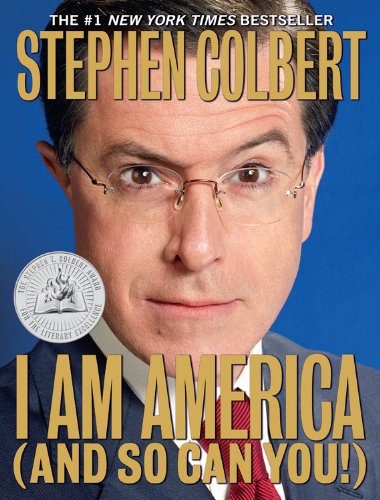
Stephen Colbert- I Am America (And So Can You!)
Just look at the groundbreaking statement Colbert is saying here. He is America. Everything you do in your life is just part of the muscle/nervous/other system of Colbert. Illegal immigrants are viruses, and the border patrol is his immune system.
Without even reading, it is still obvious that this book is going to be hilarious. There is an award on the front that depicts a burning book. The "about the author" section is a picture drawn of him in the style of the hulk, with his description being "Stephen Colbert is America." And just look at the back cover:
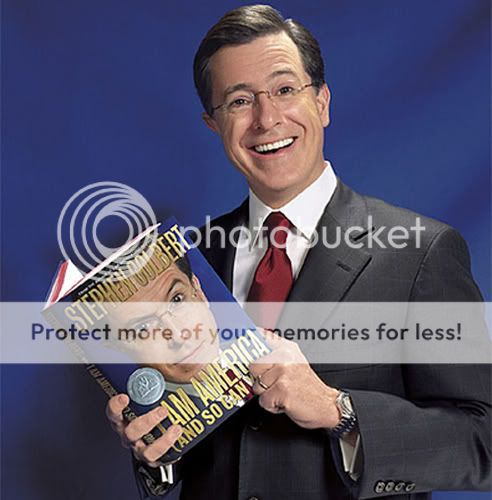
Right off the bat, I can already tell that this is going to be good. Sure enough, I decided to start reading, and it gets even funnier. He opens with lines such as "I shouted [this book] into a tape recorder over the Columbus day weekend, then handed it to my agent and said, 'sell this.'" and "Men were men, women were women, and gays were 'confirmed bachelors.'" Overall, this is looking to be a hilarious read and a book that I will surely enjoy.
Boom done (BoC part 3)
So I'm done with Breakfast of Champions.
SPOILERS SPOILERS SPOILERS
Overall, this was a great read. I really enjoyed the metafiction that was present in this book. Towards the end, Kurt Vonnegut himself appears in the book. Here, he consults kilgore trout.
This is when the last couple of words,Kilgore Trout saying "Make me young!", start to make sense. The last words of this book is kilgore trout pleading to Vonnegut to make him young. Considering that trout serves as an avatar of Vonnegut himself, what vonnegut is doing here is pleading to his creator to make him young again, so he can relive his life a better way. However, vonnegut in the novel is unable to change that about kilgore trout, representing how Vonnegut is unable to change how he turned out.
END SPOILERS
It is also interesting seeing the ways how Kilgore trout and Dwayne Hoover parallel. They frequently feel the same emotions, as shown by parallels of loneliness and isolation. This is a great setup for when they meet, and Hoover loses it. It is also interesting seeing how hoover is so easily influenced by an entirely fictional short story, as this makes a statement about how people can be easily influenced by any form of media, if they are deranged enough. This is a very powerful message today, on the onset of school shootings, where people blame the media a lot.
Overall, I enjoyed this book. Vonnegut's satire was immensly enjoyable. i found it to be very on-point at times. The messages that he conveys through Kilgore trout's stories are enjoyable, and the way he shows the degradation of Dwayne Hoover's mind is also fascinating. In fact, it feels alsmost like a Shakespearean tragedy, except, you know, more vonnegut.
However, there were some things that I didn't like about this book. Probably the biggest would be its ending. Normally, I think that the endings are the strongest part about vonnegut novels. However, I found this book's ending to be lacking, as it seemed like a twist that didn't really come from anywhere. However, I still found this to be a very enjoyable book.
Verdict: 4 Stars
Up next...

Sunday, March 9, 2014
Where there will be no Bon Jovi jokes because that song is bad and you should feel bad for liking it (BoC part 2)
Where I continue talking about Everything Sucks, Vol VII.
For one, it seems like this book is going to be less "direct" in its satire than I thought it would be. Rather than focus primarily on the idea of the media, kurt vonnegut is attacking a lot of different things. For example. as I previously mentioned, the book starts off with describing america, and keeps that going for a while.
A frequent source of themes in this story are the various novels that kilgore trout has published (Which I can't post due to the excellent SFW publishing plan he has going on), that are frequently mentioned throughout this book. For example, kilgore trout mentions that he wrote a book about a person that communicates only with farting and tap dancing (One must have assumed it sounded like Esperanto). He tries to tell earthlings how to create world peace and cure cancer, but they can't understand what he is saying, so they kill him. This is obviously a message about the importance of communication, and stories like this show up frequently in this book.
It is also a fact that whenever Kilgore Trout appears (There are recurring characters in vonnegut books that can be used to connect them all together. It's similar to Tarantino's films, except with less foot fetish), he serves as an avatar for Vonnegut himself. The fact that he has a starring role in this book means that we might get to see some insight as to what Vonnegut thinks of himself.
Another theme is the development of dwayne hoover. It has already been established that Dwayne Hoover will recieve a copy of Kilgore Trout's x that will cause him to run amok (I am guessing tht this will be the climax of the book). What this book is doing now is setting up the events that will result in Dwayne Hoover losing his mind. For example, chapter six features Dwayne Hoover repeating "Where am I?" in his hometown that he owns most of. This represents his gradual decline in identity, with is more proof of his instability.
Overall, this section is doing a nice job of setting things up for the ending. I've noticed that the ending is usually the best and most important part of a vonnegut book, so I am excited to see what this book will conclude with.
Monday, March 3, 2014
Kurt Vonnegut - Everything Sucks, Vol. VII (Part 1)
So up first:
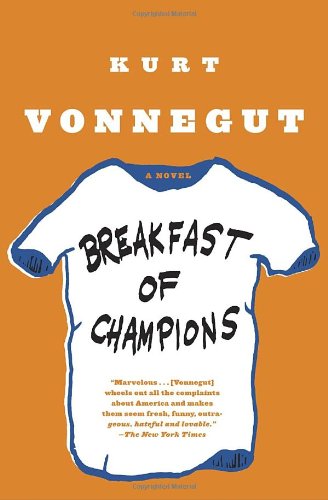
Kurt Vonnegut- Breakfast of Champions
I love Vonneugt. I have a section on my book shelf that's entirely Vonnegut books.
.JPG)
See?
This seems to be considered by most people to be the best Vonnegut book that I haven't read. Plus, it features kilgore trout. Who doesn't love kilgore trout?
From a summary of this book, it seems like this is going to cover something that I haven't seen that much in most Vonnegut books: the influence of media on behaviors. This is very personal, which is in contrast to most of the vonngut books that I've read, which deal with larger and more fantastic ideas such as
SPOILERS
All of humanity's existence being a method of an alien race to communicate with a lost member of their race, humanity driving themselves extinct, and humanity evolving into small-brained animals that are more similar to seals.
END SPOILERS
The fact that he's focusing on a person going insane because of someone else's clearly fictional writings seems much more realistic: it could very likely happen, and pretty much already has (Manson, anyone?). This gives the book a different edge now, with an increase in school shootings, with the media blaming things such as video games (instead of themselves).
However, this is still a Vonnegut book, and it shows. This starts right from page one, where he explains the united states of america from an alien's perspective ("The teachers told the children that this is when their continent was discovered by human beings. Actually, millions of human beings had been living full and imaginative lives on the continent in 1492. That was simply the year in which the sea pirates began to cheat and rob and kill them.") This shows that vonnegut still has a much larger satiric goal in mind when it comes to this book. Overall, I am really looking forward to reading this book.
This is a thing
So, I now have a blog. Hope it doesn't suck as much as the last one.
My order is:
Fiction:
Kurt Vonnegut - Breakfast of Champtions
Nonfiction:
Stephen Colbert- I Am America (And So Can You!)
Classic:
James Joyce - Dubliners
Free Choice I:
John Kennedy Toole - A Confederacy of Dunces
Free Choice II:
???
Subscribe to:
Comments (Atom)